Connecting a water fitting to the mains water, can, depending on the circumstances, introduce a risk of contamination to the main waters. Water fittings connected erroneously, might also result in amount of water being supplied not being measured correctly. Both have an adverse effect on the relevant water undertaker or water supply licensee.
Through some regulations, there are certain acts which have been made criminal offences.
This article will this, in light of:
(1) Water Supply (Water Fittings) Regulations 1999/1148 ('Water Fitting Regs'), which came into force on 1.7.99 (amended from 1.12.05)[0];
(2) Water Industry Act 1991, section 74;
(3) Wallis v Bristol Water Plc ('Wallis'), Divisional Court (Dyson LJ and Tugendhat J) on 10.12.09 (Tugendhat J gave the first judgment)[1];
It is helpful to set out the Parts to the Water Fittings Regs. They are 3 Parts:
(1) Part I - Preliminary
(2) Part II - Requirements
(3) Part III - Enforcement
There then 3 Schedules. Only 2 are relevant:
(1) Schedule 1 - Fuid Categories
(2) Schedule 2 - Requirements for water fittings.
WATER INDUSTRY ACT 1991
Chapter III of the Water Industry Act 1991 ('WIA 1991') is entitled 'Quality and sufficiency of supplies' and s.71 to s.76C appear under the heading 'Waste, contamination, misuse etc.'[2]. Section 74 of the WIA 1991 is the relevant section for present purposes[3]. It is entitled 'Regulations for preventing contamination, waste etc. and with respect to water fittings.' and it empowers the Secretary of State to make regulations for, in essence:
(a) preventing water contamination;
(b) ensuring water's quality and suitability is not prejudiced;
(c) preventing waste, undue consumption or misuse of water;
(d) avoiding erroneous measurements of water.
WATER FITTING REGS
Pursuant to s.74 (and other sections) of the WIA 1991, the Secretary of State made the Water Fittings Regs.
Part I - Application/Dis-application of Water Fittings Regs
Reg.2 is entitled 'Application of Regulations' and, as the name suggests, deals with when the Water Fittings Regs will apply. Reg 2 currently reads:
'(1) Subject to the following provisions of this regulation, these Regulations apply to any water fitting installed or used, or to be installed or used, in premises to which water is or is to be supplied by a water undertaker or water supply licensee.
(2) These Regulations do not apply to a water fitting installed or used, or to be installed or used, in connection with water supplied for purposes other than domestic or food production purposes, provided that-
(a) the water is metered;
(b) the supply of the water is for a period not exceeding one month, or, with the written consent of the water undertaker
whose supply system is used for the purposes of that supply, three months; and
(c) no water can return through the meter to any pipe vested in a water undertaker or water supply licensee.
(3) Except for the purposes of paragraph 14 of Schedule 2 (prevention of cross connection to unwholesome water), these Regulations do not apply to water fittings which are not connected or to be connected to water supplied by a water undertaker or water supply licensee.
(4) Nothing in these Regulations shall require any person to remove, replace, alter, disconnect or cease to use any water fitting which was lawfully installed or used, or capable of being used, before 1st July 1999.'
As will be apparent:
(1) Application: the Water Fittings Regs apply to any water fitting installed or used, or to be installed or used, in premises to which water is or is to be supplied by a water undertaker or water supply licensee (subject to any provision of the Water Fittings Regs);
(2) Dis-application: the Water Fittings Regs do not apply to water fittings (installed or used or to be installed or used, in connection with water supplied for purposes, other than domestic or food production purposes, provided 3 conditions are satisfied. Those 3 conditions are listed:
(a) the water must be metered;
(b) time limited supply (not exceeding 1 months, or with consent, 3 months)
(c) no returning water, through any pipe vested in a water undertaker or water supply licensee
(3) Dis-application: the Water Fittings Regs do not apply to water fittings which are not connected or to be connected to water supplied by a water undertaker or water supply licensee, except for the purposes of paragraph 14 of Schedule 2
(4) Dis-application: where there is a water fitting which was lawfully installed or used, or capable of being used, before 1st July 1999, the Water Fittings Regs do not require any person to remove, replace, alter, disconnect or cease to use that water fitting.
Part II - Overview - Requirements
Water Fittings Regs, Part II contains 4 regulations, reg.3, reg.4, reg.5 and reg.6. These are the 4 central requirements.
Part II - Requirement 1 - Restrictions on installation etc. of water fittings
Water Fittings Regs, reg.3 is entitled 'Restriction on installation etc. of water fittings' and contains the relevant restrictions on water fittings. It reads:
'(1) No person shall-
(a) instal a water fitting to convey or receive water supplied by a water undertaker or water supply licensee, or alter, disconnect or use such a water fitting; or
(b) cause or permit such a water fitting to be installed, altered, disconnected or used,
in contravention of the following provisions of this Part.
(2) No water fitting shall be installed, connected, arranged or used in such a manner that it causes or is likely to cause–
(i) waste, misuse, undue consumption or contamination of water supplied by a water undertaker or water supply licensee; or
(ii) the erroneous measurement of water supplied by a water undertaker or water supply licensee.
(3) No water fitting shall be installed, connected, arranged or used which by reason of being damaged, worn or otherwise faulty, causes or is likely to cause-
(i) waste, misuse, undue consumption or contamination of water supplied by a water undertaker or water supply licensee; or
(ii) the erroneous measurement of water supplied by a water undertaker or water supply licensee.'
As will be apparent:
(1) reg.3(1) mandates that, no person shall do any of the acts listed in (a) and (b), in contravention of the following provisions of this Part.
(a) Reg.3(1) appears in Part II Requirements, in the Water Fittings Regs. Accordingly, 'this Part' in reg.3(1) is a reference to Part II of the Water Fittings Regs, which contains reg.3, reg.4, reg.5 and reg.6.
(b) the acts which, if done, must not be done, in contravention of reg.3, reg.4, reg.5 and reg.6, are generally installing a water fitting, or causing or permitting a water fitting to be installed, or altered, or disconnected or used.
(2) the main prohibitions are contained in reg.3(2) and reg.3(3). They are fairly similar in wording. They are different after the initial starting phrase 'No water fitting shall be installed, connected, arranged or used...:' whereas,
(a) reg.3(2) then reads '...in such a manner that it causes or is likely to cause:'; whereas,
(b) reg.3(3) then reads '...which by reason of being damaged, worn or otherwise faulty, causes or is likely to cause:'
The negative effects the regulations seek to prevent, are:
(i) waste, misuse, undue consumption or contamination of water supplied by a water undertaker or water supply licensee; or
(ii) the erroneous measurement of water supplied by a water undertaker or water supply licensee
Part II - Requirement 2 - Requirements for water fittings etc.
Water Fittings Regs, reg.4 is entitled 'Requirements for water fittings etc.' and, in summary, stipulates that water fitting must meet 3 basic requirements:
(a) be of appropriate quality or standard;
(b) be suitable for the circumstances in which it is used; and
(c) be installed, connected, altered, repaired or disconnected, in a workmanlike manner.
Reg.4 currently reads:
'(1) Every water fitting shall-
(a) be of an appropriate quality and standard; and
(b) be suitable for the circumstances in which it is used.
(2) For the purposes of this regulation, a water fitting is of an appropriate quality or standard only if-
(c) it conforms to an appropriate British Standard or some other national specification which provides an equivalent level of protection and performance; or
(d) it conforms to a specification approved by the regulator.
(3) Every water fitting shall comply with the requirements of Schedule 2 to these Regulations as it applies to that fitting.
(4) Where any requirement of Schedule 2 relates to a water system, every water fitting which forms part of that system shall be fitted or, as the case may be, altered or replaced so as to comply with that requirement.
(5) Every water fitting shall be installed, connected, altered, repaired or disconnected in a workmanlike manner.
(6) For the purposes of this regulation, a water fitting is installed, connected, altered, repaired or disconnected in a workmanlike manner only if the work is carried out so as to conform-
(a) to an appropriate British Standard or some other national specification which provides an equivalent level of protection and performance;
(b) to a specification approved by the regulator; or
(c) to a method of installation approved by the water undertaker.'[4]
3 brief points here:
(1) Water Fittings Regs, reg.1, entitled 'Citation, commencement and interpretation', contains a definition of 'regulator'. Reg.1(2) states that:
'“regulator” means-
(a) in relation to any water undertakers whose area of appointment is wholly or mainly in Wales and their area of appointment, the National Assembly of Wales;
(b) in relation to all other water undertakers and their area of appointment, the Secretary of State;'
(2) see reg.12 in relation to 'specification' approval and water undertaker approval of a 'method of installation'[5];
(3) Schedule 2 is too long to set out here, or in a footnote. Reference should be made direct to the Water Fitting Regs themselves[6]. Note, reg.11 empowers a water undertaker to apply to the regulator, to authorise the relaxation of a Water Fittings Regs schedule 2 requirement[7].
Part II - Requirement 3 - Notification to water undertaker
Reg.5 is entitled 'Notification' and imposes obligations of notification. Reg.5(1) reads:
'(1) Subject to paragraph (2), any person who proposes to instal a water fitting in connection with any of the operations listed in the Table below-
(a) shall give notice to the water undertaker that he proposes to begin work;
(b) shall not begin that work without the consent of that undertaker which shall not be withheld unreasonably; and
(c) shall comply with any conditions to which the undertaker's consent is subject.'
Reg.5 then contains a Table, before setting out further (sub)regulations. Both of these are set out in a footnote[8], but in short, the further (sub)regulations are:
(1) reg.5(2) - dis-applying the regulation in respect to the '...installation by an approved contractor of a water fitting falling within paragraph 2, 4(b) or 4(g) in the Table.';
(2) reg.5(3) - stipulating what a reg.5(1) notice must contain;
(3) reg.5(4) - stipulating when a water undertaker may withhold consent;
(4) reg.5(5) - stipulating that, if the water undertaker does not give notice, with a period, reg.5(1) consent is to be deemed to have been granted unconditionally.
Any disputes between: (a) a water undertaker; and (b) a person who has installed or proposes to instal a water fitting, in respect to certain aspects of a water undertaker decisions on: (a) consent (b) conditions imposing; (c) relaxation of requirements, can be referred to arbitration (reg.13)[9].
Part II - Requirement 4 - Contractor's Certificate
The next, and last of the 4 main requirements, is reg.6, in relation to the issuance of a certificate where a water fitting is installed, altered, connected or disconnected by an approved contractor.
'(1) Where a water fitting is installed, altered, connected or disconnected by an approved contractor, the contractor shall upon completion of the work furnish a signed certificate stating whether the water fitting complies with the requirements of these Regulations to the person who commissioned the work.
(2) In the case of a fitting for which notice is required under regulation 5(1) above, the contractor shall send a copy of the certificate to the water undertaker.'
Water Fittings Regs, reg.1(2) contains a definition of 'regulator'. Reg.1(2) states that:
'“approved contractor” means a person who-
(a) has been approved by the water undertaker for the area where a water fitting is installed or used, or
(b) has been certified as an approved contractor by an organization specified in writing by the regulator;'
Part III - Criminal Offence and Penalty
This is the first regulation in Part III, which is (as stated above), entitled 'Enforcement'. Reg.7 is a key regulation:
(1) by reg.7(1), it makes contravention of some (but not all) of the 4 requirements specified in Part II to the Water Fittings Regs, a criminal offence; and
(2) by reg.7(2), it provides a defence to the criminal offence, available in any proceedings against an owner or occupier.
Reg.7 is entitled 'Penalty for contravening regulations' and reads:
'(1) Subject to the following provisions of this regulation, a person who-
(a) contravenes any of the provisions of regulation 3(1), (2) or (3) or 6(1) or (2);
(b) commences an operation listed in the Table in regulation 5(1) without giving the notice required by that paragraph;
(c) commences an operation listed in the Table in regulation 5(1) without the consent required by that paragraph; or
(d) carries out an operation listed in the Table in regulation 5(1) in breach of a condition imposed under regulation 5(4);
is guilty of an offence and liable on summary conviction to a fine not exceeding level 3 on the standard scale.
(2) In any proceedings against an owner or occupier for an offence under paragraph (1) which is based on the installation, alteration, repair, connection or disconnection of a water fitting, it shall be a defence to prove–
(a) that the work in question was carried out by or under the direction of an approved contractor, and
(b) that the contractor certified to the person who commissioned that work that the water fitting complied with the requirements of these Regulations.'
As will be apparent:
(1) subject to the reg.7(2) defence, a person who contravenes the stipulated circumstances listed in reg.7(1)(a), reg.7(1)(b), reg.7(1)(c) or reg.7(1)(d), will be guilty of a criminal offence.
(2) a person who has so committed a criminal offence, will be liable to:
(i) a summary conviction (in the Magistrates Court); and
(ii) on summary conviction, be fined by the Magistrates Court, the fine not to exceed level 3 on the standard scale (currently, a maximum of £1000 (Sentencing Council Guidance) - note that would be, per criminal offence)
(3) returning to the stipulated circumstances listed in reg.7(1)(a), reg.7(1)(b), reg.7(1)(c) or reg.7(1)(d):
(a) reg.7(1)(a) relates to the 2 of the 4 requirements: reg.3(1)(2) and (3) and reg.6(1) and 6(2);
(b) reg.7(1)(a) to (cc), all relate to 1 of the 4 requirements: reg.5 and the obligations therein;
(c) note that contravention of reg.4 is not listed in reg.7(1).
Ancillary to this, is reg.10, entitled 'Enforcement' which provides a water undertaker is required to enforce the Water Fittings Regs in relation to the area to which it holds an 1991 Act (Part II) appointment[10].
Inspections, measurements and tests
Reg.9 gives powers of inspection, measurements and tests. Entitled 'Inspections, measurements and tests', reg.9 reads:
'Any person designated in writing-
(a) for the purposes of section 74(4) or 170(3), by a water undertaker, or
(b) for the purposes of section 84(2), by any local authority,
may carry out such inspections, measurements and tests on premises entered by that person or on water fittings or other articles found on any such premises, and take away such samples of water or of any land, and such water fittings and other articles, as that person may consider necessary for the purposes for which those premises were entered.'
CASE LAW
Wallis - overview
Turning then to the Wallis case, Wallis:
(1) seems to be the only reported case[11] which considers the Water Fittings Regs;
(2) only really considers 2 aspects to the Water Fittings Regs, namely:
(a) the true meaning of 'likely' in the Water Fittings Regs, particularly, reg.3(2);
(b) (to a modest extent) the scope of reg.2(4) - the time provision.
but, as it is the only reported authority, it is helpful to consider the authority in the round.
But before considering Wallis in detail, it is convenient to summarise now, the position taken in Wallis on the meaning of 'likely': 'likely' means 'real possibility' rather than 'probable' (probable itself meaning 'more probable than not') - see Wallis, paragraphs 18 and 28 (quoted below)
Wallis - Analysis
In Wallis:
(1) Bristol Water Plc ('Bristol Water') was: (a) the water undertaker; (b) prosecutor in the Magistrates Court; (c) respondent to the appeal;
(2) Mr Wallis was (a) a dairy farm owner; (b) defendant in the Magistrates Court; (c) appellant on the appeal.
On 20.11.08, Bristol preferred an information against Mr Wallis, charging Mr Wallis with 6 offences of contravening reg.3(2)(i) of the Water Fittings Regs. That on 28.5.08, Mr Wallis had contravened the requirements of Water Fittings Regs in 6 respects. The location of the contraventions was said to have taken place on a dairy farm, to which water was supplied. Seemingly, the Water Fittings Regs applied because this was water supplied for 'food production purposes' (reg.2(2)).
The contraventions were said to relate to:
(a) 5 x hose union taps ('HUTs'; in the old dairy); and
(b) 1 x udder wash (dairy and the parlour).
And that:
(1) the areas in question, were exposed to cow excreta - a fluid category 5 risk; and
(2) there was no backflow prevention, contrary to paragraph 15 of Schedule 2 to the Water Fittings Regs, and thus,
the same were connected in such a manner as to be likely to cause contamination of water supplied by the water undertaker, contrary to regulation 3(2)(i) of the Water Fittings Regs.
Magistrates Court
In the Magistrates Court, at first instance, the justices:
(1) found that the dangers of contamination of the public water supply by backflow (see below) of pathogenic organisms, from cow excreta, had been extremely high;
(2) said that “Whilst the probability of such an event from any individual, non-compliant installation might not be great, the consequences of such an event have the potential to be catastrophic to public health. The phrase, ‘likely to cause contamination of the water supply’ has to take into account both the actual likelihood of the event and the severity of the consequences …' (Wallis, paragraph 10 (paragraph (6))
(3) convicted Mr Wallis.
Mr Wallis appealed by way of case stated, which was listed before the Divisional Court.
Divisional Court
As stated, a central legal question was as to the meaning of the word 'likely', as it appears in regulations creating an offence, in particular regulation 3(2) of the Water Fittings Regs. It will be recalled that:
(a) reg.3(2)(i) provides as follows:
'No water fitting shall be installed, connected, arranged or used in such a manner that it causes or is likely to cause-
(i) waste, misuse, undue consumption or contamination of water supplied by a water undertaker or water supply licensee;' [bold added]
And, reg.3(1) prohibits anyone from contravening reg.3(2), when installing a water fitting, or altering, disconnecting or using such a water fitting, or causing or permitting such a water fitting to be installed, altered, disconnected or used.
(b) Mr Wallis was charged on the basis that on 28.5.08, the relevant water fittings had been 'likely to cause' (rather than had caused) contamination of water supplied by a water undertaker.
Tugendhat J observed that:
(1) the Water Fittings Regs made '...provision for the prevention by a water undertaker of contamination of water. The purpose is to protect the health of the public.' (paragraph 2)
(2) 'By regulation 7(1)(a) it is provided that a person who contravenes any of the provisions of regulation 3(2) is guilty of an offence. By regulation 4, it is provided that
“(3) Every water fitting shall comply with the requirements of Schedule 2 to these Regulations as it applies to that fitting.
“(4) Where any requirement of Schedule 2 relates to a water system, every water fitting which forms part of that system shall be fitted or, as the case may be, altered or replaced so as to comply with that requirement.”' (paragraph 5)
(3) 'There is provision to avoid the regulations having retrospective effect. Regulation 2(4) provides: “Nothing in these Regulations shall require any person to remove, replace, alter, disconnect or cease to use any water fitting which was lawfully installed or used, or capable of being used, before 1 July 1999.”' (paragraph 6)
(4) noted, in relation to 'backflow', that:
(a) Schedule 2, paragraph 1, provided that 'backflow' - 'means flow upstream, that is in a direction contrary to the intended normal direction of flow, within or from a water fitting … ‘contamination’ includes any reduction in chemical or biological quality of water due to a change in temperature or the introduction of polluting substances.' (paragraph 4)
(b) Schedule 2, paragraph 15, provided:
'(4) Backflow prevention shall be provided on any supply pipe or distributing pipe … (b) where the water undertaker has given notice for the purposes of this Schedule that such prevention is needed for the whole or part of any premises.
(5) A backflow prevention device is adequate for the purposes of paragraph (1) if it is in accordance with a specification approved by the regulator for the purposes of this Schedule.'
(5) 'There are five categories of water under the [Water Fittings Regs] which are defined in Schedule 1, as amended. Fluid category 1 is: “Wholesome water supplied by a water undertaker or licensed water supplier and complying with the requirements of regulations made under section 67 of the Water Industry Act 1991”. Fluid category 5 is:
“Fluid representing a serious health hazard because of the concentration of pathogenic organisms, radioactive or very toxic substances, including any fluid which contains - (a) faecal material or other human waste; (b) butchery or other animal waste; or (c) pathogens from any other source.”' (paragraph 8)
'Likely'
As to the meaning of 'likely', Tugendhat J, at paragraphs 13 to 16, considered the cases of: (a) Parkin v Norman [1983] 1 QB 92; and (b) In re H (Minors) (Sexual Abuse: Standard of Proof) [1996] AC 563, as to the approach to discerning the meaning Parliament had intended, for the word 'likely', in that statutory provision/context:
'In some criminal statutes the word “likely” does mean “probable”. In Parkin v Norman [1983] 1 QB 92 the Divisional Court had to construe the word “likely” as it occurs in section 5 of the Public Order Act 1936, which reads:
“Any person who in any public place … uses threatening, abusive or insulting words or behaviour with intent to provoke a breach of the peace or whereby a breach of the peace is likely to be occasioned, shall be guilty of an offence.”
In that case counsel submitted that “likely” meant “probably”: see p 97 g. The court held, at p 98: “Our task is to construe the words of section 5 in the light of the Act as a whole, including its long title, to which reference can properly be made if the words of the section are ambiguous.”
In that context the court said, at p 100:
“It is to be noted that the words of the statute are: ‘whereby a breach of the peace is likely to be occasioned’ and not ‘whereby a breach of the peace is liable to be occasioned’. This is a penal measure and the courts must take care to see that the former expression is not treated as if it were the latter.”
On the other hand, in In re H (Minors) (Sexual Abuse: Standard of Proof) [1996] AC 563, 584, Lord Nicholls of Birkenhead considered the meaning of the word in section 31 of the Children Act 1989. This is not a penal statute, but section 31 is addressed to the risk of child sexual abuse. He said, at pp 584–585:
“I shall consider first the meaning of ‘likely’ in the expression ‘likely to suffer significant harm’ in section 31. In your Lordships' House Mr Levy advanced an argument not open in the courts below. He submitted that likely means probable, and that the decision of the Court of Appeal to the contrary in Newham London Borough Council v Attorney General [1993] 1 FLR 281 was wrong. I cannot accept this contention.
“In everyday usage one meaning of the word likely, perhaps its primary meaning, is probable, in the sense of more likely than not. This is not its only meaning. If I am going walking on Kinder Scout and ask whether it is likely to rain, I am using likely in a different sense. I am inquiring whether there is a real risk of rain, a risk that ought not to be ignored. In which sense is likely being used in this subsection?
“In section 31(2) Parliament has stated the prerequisites which must exist before the court has power to make a care order. These prerequisites mark the boundary line drawn by Parliament between the differing interests. On one side are the interests of parents in caring for their own child, a course which prima facie is also in the interests of the child. On the other side there will be circumstances in which the interests of the child may dictate a need for his care to be entrusted to others. In section 31(2) Parliament has stated the minimum conditions which must be present before the court can look more widely at all the circumstances and decide whether the child's welfare requires that a local authority shall receive the child into their care and have parental responsibility for him. The court must be satisfied that the child is already suffering significant harm. Or the court must be satisfied that, looking ahead, although the child may not yet be suffering such harm, he or she is likely to do so in the future. The court may make a care order if, but only if, it is satisfied in one or other of these respects.
“In this context Parliament cannot have been using likely in the sense of more likely than not. If the word likely were given this meaning, it would have the effect of leaving outside the scope of care and supervision orders cases where the court is satisfied there is a real possibility of significant harm to the child in the future but that possibility falls short of being more likely than not. Strictly, if this were the correct reading of the Act, a care or supervision order would not be available even in a case where the risk of significant harm is as likely as not. Nothing would suffice short of proof that the child will probably suffer significant harm.
“The difficulty with this interpretation of section 31(2)(a) is that it would draw the boundary line at an altogether inapposite point. What is in issue is the prospect, or risk, of the child suffering significant harm. When exposed to this risk a child may need protection just as much when the risk is considered to be less than 50–50 as when the risk is of a higher order. Conversely, so far as the parents are concerned, there is no particular magic in a threshold test based on a probability of significant harm as distinct from a real possibility. It is otherwise if there is no real possibility. It is eminently understandable that Parliament should provide that where there is no real possibility of significant harm, parental responsibility should remain solely with the parents. That makes sense as a threshold in the interests of the parents and the child in a way that a higher threshold, based on probability, would not.
“In my view, therefore, the context shows that in section 31(2)(a) likely is being used in the sense of a real possibility, a possibility that cannot sensibly be ignored having regard to the nature and gravity of the feared harm in the particular case. By parity of reasoning the expression likely to suffer significant harm bears the same meaning elsewhere in the Act; for instance, in sections 43, 44 and 46. Likely also bears a similar meaning, for a similar reason, in the requirement in section 31(2)(b) that the harm or likelihood of harm must be attributable to the care given to the child or ‘likely’ to be given him if the order were not made.”'
Turning to the circumstances in Wallis, at paragraph 17, Tugendhat J said:
'In the present case the justices had found that the dangers of contamination of the public water supply by backflow of pathogenic organisms from cow excreta are extremely high. In saying that the word “likely” has to take into account both the likelihood of the event and the severity of the consequences, they were approaching the legislation consistently with the guidance given by Lord Nicholls.'
Then, at paragraph 18, Tugendhat J in Wallis concluded:
'In my judgment, “likely” in these Regulations is being used in the sense of a real possibility, a possibility that cannot sensibly be ignored having regard to the nature and gravity of the feared harm to public health in the particular case. This interpretation does not offend against any principle of the criminal law. Parkin v Norman [1983] 1 QB 92 does not require that in all penal measures the court must take care to see that “likely” is not treated as if it meant “liable”. As the court said in that case, the court's task is to construe the words of the section in light of the Act as a whole.'
Dyson LJ in Wallis agreed with Tugendhat J's interpretation of 'likely' (paragraph 28). Dyson J said that:
(1) '...the word “likely” can mean “probable or “a real possibility”.' (paragraph 23) (as per Lord Nicholls of Birkenhead said in In re H (Minors) (Sexual Abuse: Standard of Proof [1996] AC 563, 584f);
(2) 'Which of these meanings the word bears in regulation 3(2) of the Water Supply (Water Fittings) Regulations 1999 depends on the true interpretation of the provision read in the context of the Regulations as a whole' (paragraph 23)
Turning then to the context of the Water Fittings Regs, as a whole, Dyson LJ said, at paragraphs 23 to 25 of Wallis:
'The Regulations are made pursuant to section 74(1) of the Water Industry Act 1991, as amended by sections 101(1) and 105(3) of and paragraph 23(a) of Schedule 8 to the Water Act 2003, which, so far as material, provides:
“(1) The Secretary of State may by regulations make such provision as he considers appropriate for any of the following purposes, that is to say—(a) for securing—(i) that water in a water main or other pipe of a water undertaker is not contaminated; and (ii) that its quality and suitability for particular purposes is not prejudiced, by the return of any substance from any premises to that main or pipe; (b) for securing that water which is in any pipe connected with any such main or other pipe or which has been supplied to any premises by a water undertaker or licensed water supplier is not contaminated, and that its quality and suitability for particular purposes is not prejudiced, before it is used.”
Regulation 3(2) of the 1999 Regulations is therefore made to provide health protection against contamination, inter alia, of mains water. The justices made an important finding in the case stated: “the dangers of contamination of the public water supply by backflow of pathogenic organisms and cow excreta are extremely high.”
Having regard to the health interests at stake and the potential for significant harm in the event of water contamination, in my judgment it is inherently unlikely that Parliament or the Secretary of State would have intended that the restriction imposed by regulation 3(2) of the 1999 Regulations should be limited to cases where it was more probable than not that contamination of the water supply would occur. In my view, the stated objective of section 74(1) of the 1991 Act and of the 1999 Regulations shows that the word “likely” is being used in the sense of “a real possibility”.'
Dyson LJ rejected, at paragraph 27, an argument that '...since a breach of regulation 3(2) is a criminal offence (see regulation 7(1)(a) ), any ambiguity in the meaning of “likely” should be resolved in favour of the defendant since it has not been made clear that “likely” connotes no more than a real possibility.' (paragraph 26) - that '...it must have been intended that “likely” should bear the meaning more generous to the defendant of “probable”.' (paragraph 26). Dyson LJ explained that:
'It is true that a breach of regulation 3(2) is a criminal offence, but the statutory purpose of regulation 2 is the protection of persons against the severe consequences to their health of the contamination of water. That purpose would be substantially undermined if the prohibition in regulation 3(2) were restricted to a prohibition on the installing, connecting or using of a fitting in such manner that it causes or is more probable than not to cause water contamination. I accept that generally any ambiguity in a penal provision should be construed in favour of a defendant, but that is not an immutable proposition of law. It is always necessary to have regard to the statutory context and the legislative purpose.' (paragraph 27)
Reg.2(4) - Limited retrospective effect of Water Fittings Regs
Separately, there was further question to the Case Stated appeal. The question (labelled Question (b)) was:
'Having found that the udder wash may have been lawfully installed prior to 1 July 1999, were we entitled to find that the statutory defence contained within regulation 2(4) of the Regulations do not apply in [the defendant's] case because the water undertaker (Bristol Water) had given notice under [paragraph 15(4)(b) of Schedule 2 to the Regulations] that the backflow protection was required?'
(To refresh, reg.2(4) reads: 'Nothing in these Regulations shall require any person to remove, replace, alter, disconnect or cease to use any water fitting which was lawfully installed or used, or capable of being used, before 1st July 1999.')
As to this Tugendhat J in Wallis:
(1) said he preferred the water undertaker Bristol Water's arguments. that is, that regulation 2(4) only applies to requirements which are contained in the regulations themselves, and does not apply to a requirement made in a notice issued pursuant to paragraph 15 of Schedule 2 to the 1999 Regulations. Otherwise...there would be nothing that could be done about an installation which was in place before 1 July 1999, but which the water undertaker found to be a danger to public health by reason of the inadequacy of the protection against backflow (paragraph 21)
(2) concluding that, Question (b) should be answered in the affirmative. In other words, that the justices had been entitled to find that the statutory defence, contained within regulation 2(4) of the Regulations do not apply in [the defendant's] case, because the water undertaker (Bristol Water) had given notice under [paragraph 15(4)(b) of Schedule 2 to the Regulations] that the backflow protection was required.
SIMON HILL © 2026*
BARRISTER
33 BEDFORD ROW
NOTICE: This article is provided free of charge for information purposes only; it does not constitute legal advice and should not be relied on as such. No responsibility for the accuracy and/or correctness of the information and commentary set out in the article, or for any consequences of relying on it, is assumed or accepted by any member of Chambers or by Chambers as a whole, or the Copyright holder. No attempt has been made to provide an exhaustive review/account of the law in this area. *Copyright is owned by Barrister Search Limited.
[0] In the Water Supply (Water Fittings) Regulations 1999/1148 ('Water Fittings Regs'), the Preamble states:
'The Secretary of State for the Environment, Transport and the Regions and the Secretary of State for Wales acting jointly, in exercise of their powers under sections 74, 84 and 213(2) of the Water Industry Act 1991, hereby make the following Regulations:'
The Preamble also states that the Water Fittings Regs:
(1) (was) Made: 1.4.99
(2) Laid before Parliament: 14.4.99
(3) 'Coming into force: 1.7.99'
In Water Fittings Regs, reg.1(1) states:
'These Regulations may be cited as the Water Supply (Water Fittings) Regulations 1999 and shall come into force on 1st July 1999.'
With effect from 1.12.05, Water Act 2003 (Consequential and Supplementary Provisions) Regulations 2005/2035 amended the Water Supply (Water Fittings) Regulations 1999. The regulations in the Water Act 2003 (Consequential and Supplementary Provisions) Regulations 2005/2035 which did the amending, were reg.8 and reg.16.
(1) Reg.8 of the Water Act 2003 (Consequential and Supplementary Provisions) Regulations 2005/2035 is entitled 'Amendments to the Water Supply (Water Fittings) Regulations 1999' and reads:
'(1) The Water Supply (Water Fittings) Regulations 19991 are amended as follows.
(2) In regulation 2 (application of regulations)—
(a) in paragraph (1), after “water undertaker” there is inserted “or licensed water supplier”;
(b) in paragraph (2)(b), after “water undertaker” there is inserted “whose supply system is used for the purposes of that supply”;
(c) in paragraph (2)(c), after “water undertaker” there is inserted “or licensed water supplier”; and
(d) in paragraph (3), after “water undertaker” there is inserted “or licensed water supplier”.
(3) In regulation 3 (restriction on installation etc of water fittings), after “water undertaker”, in each place where it appears, there is inserted “or licensed water supplier”.
(4) In paragraph 5 of the table in regulation 5 (notification) after “water undertaker” there is inserted “or licensed water supplier”.
(5) In regulation 12 (approval by the regulator or the water undertaker), after paragraph (1)(a), there is inserted—
“(aa) every licensed water supplier;”.
(6) In Schedule 1 (fluid categories), in the paragraph entitled “Fluid category 1”, after “water undertaker” there is inserted “or licensed water supplier”.
(7) In Schedule 2 (requirements for water fittings)—
(a) in paragraph 6, after “water undertaker” there is inserted “or licensed water supplier”;
(b) in paragraph 8, after “water undertaker” there is inserted “or licensed water supplier”;
(c) in paragraph 11, for “Water supply systems”, there is substituted “Water systems”; and
(d) in paragraph 14(1)(a), after “water undertaker” there is inserted “or licensed water supplier”.'
(2) Reg.16 of the Water Act 2003 (Consequential and Supplementary Provisions) Regulations 2005/2035 is entitled 'Amendment to the Water Supply (Water Fittings) Regulations 1999' and reads:
'In regulation 10 (enforcement) of the Water Supply (Water Fittings) Regulations 1999, in paragraph (2)(b), for “Director” there is substituted “Authority”.'
[1] The Divisional Court is a court sitting at the High Court level. Divisional Courts have more than 1 judge determining the case.
[2] The Water Industry Act 1991, Chapter III, subpart 'Waste, contamination, misuse etc.' contains sections 71 to 76C. To give a flavour (and it is only a flavour) of the first couple of sections, which make certain acts, criminal offences:
(1) section 71 of the Water Industry Act 1991 is entitled 'Waste from water sources' and s.71(1) reads:
'Subject to subsections (2) and (3) below, a person shall be guilty of an offence under this section if-
(a) he causes or allows any underground water to run to waste from any well, borehole or other work; or
(b) he abstracts from any well, borehole or other work water in excess of his reasonable requirements.'
(2) section 72 of the Water Industry Act 1991 is entitled 'Contamination of water sources.' and s.72(1) reads:
'Subject to subsections (2) and (3) below, a person is guilty of an offence under this section if he is guilty of any act or neglect whereby the water in any waterworks which is used or likely to be used-
(a) for human consumption or domestic purposes; or
(b) for manufacturing food or drink for human consumption, is polluted or likely to be polluted.'
s.72(5) reads:
'In this section “waterworks” includes-
(a) any spring, well, adit, borehole, service reservoir or tank; and
(b) any main or other pipe or conduit of a water undertaker; and
(c) any pipe or conduit of a water supply licensee.'
(3) section 73 of the Water Industry Act 1991 is entitled 'Offences of contaminating, wasting and misusing water etc.' and s.73(1) reads:
'If any person who is the owner or occupier of any premises to which a supply of water is provided by a water undertaker or water supply licensee intentionally or negligently causes or suffers any water fitting for which he is responsible to be or remain so out of order, so in need of repair or so constructed or adapted, or to be so used
(a) that water in a water main or other pipe of a water undertaker, or in a pipe connected with such a water main or pipe, is or is likely to be contaminated by the return of any substance from those premises to that main or pipe;
(b) that water that has been supplied by the undertaker or licensee to those premises is or is likely to be contaminated before it is used; or
(c) that water so supplied is or is likely to be wasted or, having regard to the purposes for which it is supplied, misused or unduly consumed,
that person shall be guilty of an offence and liable, on summary conviction, to a fine not exceeding level 3 on the standard scale.'
It is interesting to note s.73(1A), as it was inserted into the Water Industry Act 1991, by Water Supply (Water Fittings) Regulations 1999, reg.8 (since 1.7.99). Section 73(1A) of the Water Industry Act 1991 reads:
'In any proceedings under subsection (1) above it shall be a defence to prove–
(a) that the contamination or likely contamination, or the wastage, misuse or undue consumption, was caused (wholly or mainly) by the installation, alteration, repair or connection of the water fitting on or after 1st July 1999;
(b) that the works were carried out by or under the direction of an approved contractor within the meaning of the Water Supply (Water Fittings) Regulations 1999; and
(c) that the contractor certified to the person who commissioned those works that the water fitting complied with the requirements of those regulations.'
[3] The Water Industry Act 1991, s.74 is entitled 'Regulations for preventing contamination, waste etc. and with respect to water fittings' and currently reads:
'(1) The Secretary of State may by regulations make such provision as he considers appropriate for any of the following purposes, that is to say-
(a) for securing-
(i) that water in a water main or other pipe of a water undertaker is not contaminated; and
(ii) that its quality and suitability for particular purposes is not prejudiced, by the return of any substance from any premises to that main or pipe;
(b) for securing that water which is in any pipe connected with any such main or other pipe or which has been supplied to any premises by a water undertaker or water supply licensee is not contaminated, and that its quality and suitability for particular purposes is not prejudiced, before it is used;
(c) for preventing the waste, undue consumption and misuse of any water at any time after it has left the pipes of a water undertaker for the purpose of being supplied by that undertaker or that or another water supply licensee to any premises; and
(d) for securing that water fittings installed and used by persons to whom water is or is to be supplied by a water undertaker or water supply licensee are safe and do not cause or contribute to the erroneous measurement of any water or the reverberation of any pipes.
(2) Without prejudice to the generality of subsection (1) above, regulations under this section may, for any of the purposes specified in that subsection, make provision in relation to such water fittings as may be prescribed-
(a) for forbidding the installation, connection or use of the fittings if they have not been approved under the regulations or if they contravene the regulations;
(b) for requiring the fittings, for the purposes of provision made by virtue of paragraph (a) above, to be of such a size, nature, strength or workmanship, to be made of such materials or in such a manner or to conform to such standards as may be prescribed by or approved under the regulations;
(c) for imposing such other requirements as may be prescribed with respect to the installation, arrangement, connection, testing, disconnection, alteration and repair of the fittings and with respect to the materials used in their manufacture;
(d) for the giving, refusal and revocation, by prescribed persons, of approvals required for the purposes of the regulations; and
(e) for such approvals to be capable of being made subject to such conditions as may be prescribed and for the modification and revocation of any such condition.
(3) Without prejudice as aforesaid, regulations under this section may-
(a) impose separate or concurrent duties with respect to the enforcement of the regulations on water undertakers, local authorities and such other persons as may be prescribed;
(b) confer powers on a water undertaker or local authority to carry out works and take other steps, in prescribed circumstances, for remedying any contravention of the regulations;
(c) provide for the recovery by a water undertaker or local authority of expenses reasonably incurred by the undertaker or authority in the exercise of any power conferred by virtue of paragraph (b) above;
(d) repeal or modify the provisions of section 73 above or section 75 below;
(e) provide for a contravention of the regulations to constitute a summary offence punishable, on summary conviction, by a fine not exceeding level 5 on the standard scale or such smaller sum as may be prescribed;
(f) require prescribed charges to be paid to persons carrying out functions under the regulations;
(g) enable the Secretary of State to authorise such relaxations of and departures from such of the requirements of the regulations as may be prescribed, to make any such authorisation subject to such conditions as may be prescribed and to modify or revoke any such authorisation or condition;
(h) enable the Secretary of State to authorise a water undertaker or local authority (either instead of the Secretary of State or concurrently with him) to exercise any power conferred on the Secretary of State by regulations made by virtue of paragraph (g) above; and
(i) require disputes arising under the regulations to be referred to arbitration and for determinations under the regulations to be subject to such rights of appeal as may be prescribed.
(4) Without prejudice to sections 84 and 170 below, any person designated in writing for the purposes of this subsection in such manner as may be prescribed may-
(a) enter any premises for the purpose of-
(i) ascertaining whether any provision contained in or made or having effect under this Act with respect to any water fittings or with respect to the waste or misuse of water is being or has been contravened;
(ii) determining whether, and if so in what manner, any power or duty conferred or imposed on any person by regulations under this section should be exercised or performed; or
(iii) exercising any such power or performing any such duty; or
(b) carry out such inspections, measurements and tests on premises entered by that person or on water fittings or other articles found on any such premises, and take away such samples of water or of any land and such water fittings and other articles, as that person has been authorised to carry out or take away in accordance with regulations under this section.
(5) Part II of Schedule 6 to this Act shall apply to the rights and powers conferred by subsection (4) above.
(6) The power of the Secretary of State under this section to make regulations with respect to the matters specified in the preceding provisions of this section shall include power, by regulations under this section-
(a) to modify the operation of Schedule 2 to the Water Consolidation (Consequential Provisions) Act 1991 in relation to any byelaws made under section 17 of the Water Act 1945 which have effect by virtue of paragraph 19 of Schedule 26 to the Water Act 1989 and that Schedule 2; and
(b) to revoke or amend any such byelaws;
but, so long as any such byelaws so have effect, the references in sections 47(2)(g), 53(2)(c) and 55(4) above to such regulations under this section as are prescribed shall have effect as including references to those byelaws.
(7) Any sums received by the Secretary of State in consequence of the provisions of any regulations under this section shall be paid into the Consolidated Fund.
(8) In this section “safe” has the same meaning as in Part II of the Consumer Protection Act 1987.'
[4] The Water Supply (Water Fittings) Regulations 1999/1148, reg.4(2) has 2 sub-sentences. For these sub-sentences, it would be expected that they are labelled (a) and (b). But they are labelled (cc) and (d). This of course has no affect on the meaning or operation of the regulations, but, it is an oddity.
[5] The Water Supply (Water Fittings) Regulations 1999/1148, reg.11 is entitled 'Relaxation of requirements' and reads:
'(1) Where a water undertaker considers that any requirement of Schedule 2 to these Regulations would be inappropriate in relation to a particular case, the undertaker may apply to the regulator to authorise a relaxation of that requirement.
(2) The water undertaker shall give notice of any proposed relaxation in such manner and to such persons as the regulator may direct.
(3) The regulator may grant the authorisation applied for with such modifications and subject to such conditions as he thinks fit.
(4) The regulator shall not grant an authorisation before the expiration of one month from the giving of the notice, and shall take into consideration any objection which may have been received by him.
(5) A water undertaker to whom an authorisation is granted under paragraph (3) in a particular case may relax the requirements of Schedule 2 in that case in accordance with the terms of that authorisation.'
[6] Schedule 2 to the Water Supply (Water Fittings) Regulations 1999/1148 is entitled 'Requirements for water fittings'. It contains 31 paragraphs. The first paragraph, paragraph 1, provides a list of definitions, for Schedule 2. Readers can find the full wording to Schedule 2 to the Water Supply (Water Fittings) Regulations 1999/1148 on www.legislation.gov.uk website.
[7] Water Supply (Water Fittings) Regulations 1999/1148, reg.12 is entitled 'Approval by the regulator or the water undertaker' and reads:
'(1) Before approving a specification under regulation 4 or under Schedule 2, the regulator shall consult
(a) every water undertaker;
(aa) every water supply licensee;
(b) such trade associations as he considers appropriate; and
(c) such organisations appearing to him to be concerned with the interests of water users as he considers appropriate.
(2) Where the regulator approves a specification under regulation 4 or under Schedule 2, he shall give notice of the approval to all persons who were consulted under paragraph (1) and shall publish it in such manner as he considers appropriate.
(3) Where the water undertaker approves a method of installation under regulation 4, the undertaker shall give notice of the approval to the regulator and shall publish it in such manner as the undertaker considers appropriate.
(4) This regulation applies to the revocation or modification of an approval as it applies to the giving of that approval.'
[8] In Water Supply (Water Fittings) Regulations 1999/1148 ('Water Fitting Regs'),
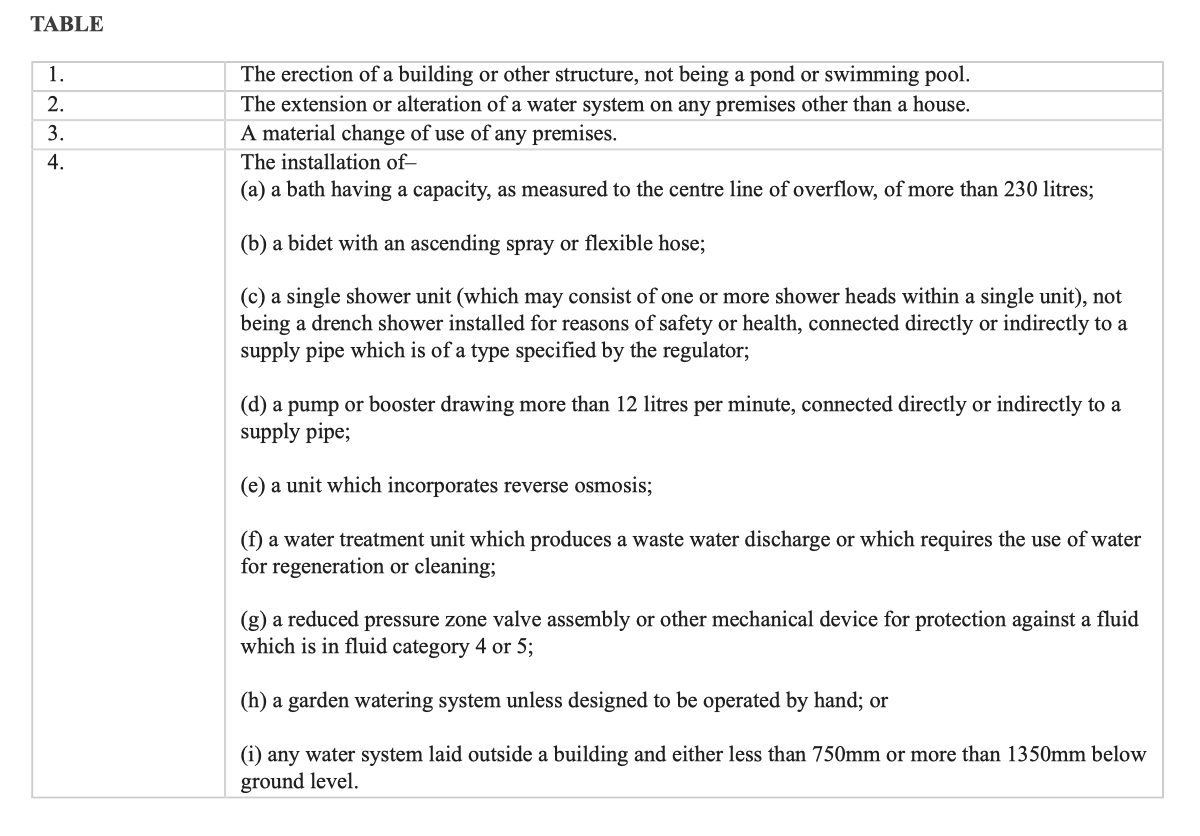 .
.

(2) This regulation does not apply to the installation by an approved contractor of a water fitting falling within paragraph 2, 4(b) or 4(g) in the Table.
(3) The notice required by paragraph (1) shall include or be accompanied by–
(a) the name and address of the person giving the notice, and (if different) the name and address of the person on whom notice may be served under paragraph (4) below;
(b) a description of the proposed work or material change of use, and
(c) particulars of the location of the premises to which the proposal relates, and the use or intended use of those premises;
(d) except in the case of a fitting falling within paragraph 4(a), (c), (h) or 5 in the Table above-
(i) a plan of those parts of the premises to which the proposal relates, and
(ii) a diagram showing the pipework and fitting to be installed; and
(e) where the work is to be carried out by an approved contractor, the name of the contractor.
(4) The water undertaker may withhold consent required under paragraph (1), or grant it subject to conditions, by a notice given before the expiry of the period of ten working days commencing with the day on which notice under that paragraph was given.
(5) If no notice is given by the water undertaker within the period mentioned in paragraph (4), the consent required under paragraph (1) shall be deemed to have been granted unconditionally.'
Note, reg.1(2) contains the following definition:
'“supply pipe” means so much of any service pipe as is not vested in the water undertaker; and paragraph 1 of Schedule 2 has effect for the purposes of that Schedule.'
[9] The Water Supply (Water Fittings) Regulations 1999/1148, reg.13 is entitled 'Disputes' and reads:
'Any dispute between a water undertaker and a person who has installed or proposes to instal a water fitting-
(a) as to whether the water undertaker has unreasonably withheld consent, or attached unreasonable conditions, under regulation 5 above; or
(b) as to whether the water undertaker has unreasonably refused to apply to the regulator for a relaxation of the requirements of these Regulations, shall be referred to arbitration by a single arbitrator to be appointed by agreement between the parties or, in default of agreement, by the regulator.'
[10] The Water Supply (Water Fittings) Regulations 1999/1148, reg.10 is entitled 'Enforcement' and reads:
'(1) A water undertaker shall enforce the requirements of these Regulations in relation to the area for which it holds an appointment under Part II of the Act.
(2) The duty of a water undertaker under this regulation shall be enforceable under section 18 of the Act-
(a) by the regulator; or
(b) with the consent of or in accordance with a general authorisation given by the regulator, by the Authority.'
[11] The only other cases which mention the Water Supply (Water Fittings) Regulations 1999/1148 - and it is only in passing - with no analysis, are:
(1) 199 Knightsbridge Development Ltd v WSP UK Ltd [2014] EWHC 43 (TCC), paragraph 20;
(2) Albion Water Ltd v Water Services Regulation Authority (formerly Director General of Water Services) [2006] CAT 23; [2007] Comp. A.R. 22, paragraph 79